Calculator

Weighted GPA Calculator

Calculate your weighted and unweighted GPA with AP, IB (+1.0), and Honors (+0.5) class weights

90% OFF

Next.js 16 SaaS Starter Kit

Full-Stack Auth, MongoDB & Stripe • Only $1.90 with code ANAS90

Get for $1.90

Course & Grade Details

Course 1

Course 2

Course 3

How to Use the Weighted GPA Calculator

1. Select the rigor level: Regular (4.0 max), Honors (+0.5 boost), or AP/IB (+1.0 boost)

2. Select the letter grade received in the course

3. Enter course credit hours (typically 1.0 or 0.5)

4. Click "Calculate Weighted GPA" to see both your weighted and unweighted averages

Course Rigor Weighting System:

Regular Courses:Standard 4.0 scale (A=4.0, B=3.0)
Honors Courses:+0.5 point boost (A=4.5, B=3.5)
AP / IB / Dual:+1.0 point boost (A=5.0, B=4.0)

Weighted GPA Calculator - Complete Guide to AP, IB & Honors Scaling

What is a Weighted GPA and How Does It Work?

A Weighted GPA reflects both academic achievement and the rigor of the academic curriculum. Unlike an unweighted GPA that treats all classes equally on a 4.0 maximum scale, a weighted GPA awards bonus grade points for challenging coursework such as Advanced Placement (AP), International Baccalaureate (IB), and Honors courses.

Weighted vs. Unweighted GPA Comparison

Calculation Formula:

Weighted GPA = Sum[(Base Grade Points + Course Weight) × Credits] ÷ Total Credits

Example: An 'A' in AP Chemistry (5.0 pts × 4 cr) + an 'A' in Regular Literature (4.0 pts × 3 cr) = 32 points ÷ 7 credits = 4.57 Weighted GPA.

Why Do University Admissions Evaluate Both GPAs?

Admissions officers at competitive colleges evaluate your unweighted GPA to assess core grading consistency, while reviewing your weighted GPA to gauge your willingness to challenge yourself with advanced coursework.
Reviewed by Academic AdvisorsUGC & AICTE Compliant

Weighted GPA Calculator

Calculate your weighted and unweighted GPA for high school and college courses with AP, IB (+1.0), and Honors (+0.5) grade boosts on a 5.0 scale.

Weighted GPA Formula

Weighted GPA = Σ[(Base Grade Points + Weight Boost) × Credits] ÷ Σ(Credits)

Where Regular courses have +0 boost (4.0 max), Honors courses have +0.5 boost (4.5 max), and AP/IB courses have +1.0 boost (5.0 max).

How to Use

  1. 1

    Select course rigor: Regular (4.0 max), Honors (+0.5 boost), or AP / IB (+1.0 boost)

  2. 2

    Choose the letter grade received for each course (A, B, C, etc.)

  3. 3

    Enter course credit hours (typically 1.0 or 0.5)

  4. 4

    View your Weighted GPA (up to 5.0), Unweighted GPA (4.0 scale), and total boost instantly

Weighted vs Unweighted Example

For an 'A' in AP Calculus (5.0 pts, 4 credits) and 'A' in Regular English (4.0 pts, 3 credits): Total Weighted Points = (5.0×4) + (4.0×3) = 32. Total Credits = 7. Weighted GPA = 32/7 = 4.57 (vs. 4.00 Unweighted).

Weighted GPA Calculator Academic Methodology & Standards

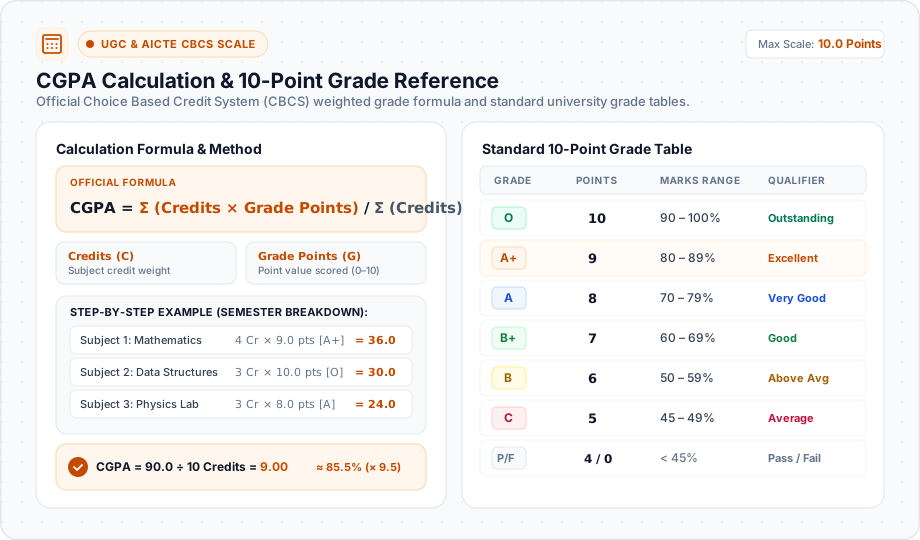
This calculator strictly adheres to official academic guidelines established by the University Grants Commission (UGC) and All India Council for Technical Education (AICTE) Choice Based Credit System (CBCS), as well as standard 4.0 GPA scales used across international universities.

Standard 10-Point Scale (CBCS)Formula: Σ(Grade Points × Credits) ÷ Σ(Credits). Adopted by central & state universities (VTU, Anna Univ, Mumbai Univ, AKTU).
Standard 4.0 GPA ScaleFormula: Weighted Grade Point Average standard for US, Canadian, and global admissions evaluation.
CGPA Calculator 10 Point Grading Scale and Calculation Formula Chart

Frequently Asked Questions About Weighted GPA Calculator

Creator's Kit Save 50+ Hrs

Next.js 16 SaaS Starter Kit

Stop building Auth, DB, and Stripe from scratch. Build your startup, portfolio, or college capstone project in 1 weekend.

Next.js 16 App Router & Tailwind
Full-Stack Auth & Protected Routes
MongoDB Database & Schemas
Stripe Checkout & Webhooks
$19$1.90 90% OFF
First 5 Early Birds Only!
Get for $1.90 (Use ANAS90)
Instant Download • 100% Full Source Code

Share This Tool

Help other students discover this free calculator

Related Guides

Quick Tips

  • Double-check your credit hours for accuracy
  • Include all completed courses
  • Use official grade values from your institution
  • Keep records for future reference

Learn More